


When working on lowering your handicap in PGA Tour 2K25 one of the most important skills to master is dialing in your landing points to accurately place your ball wherever you need it, and to do that you have to become an expert at adjusting for the variables that impact every shot.
One of the most critical variables to understand is the wind and how it alters your shots. Winds may push your ball further or stop it dead in its tracks, while crosswinds can lead to significant sideways drift between the target point and the actual landing point. If you’re struggling to refine your windy play, here is what you need to know to become a wind wizard.
What Factors Matter When Adjusting For Wind?


Operation Sports App
Your ultimate companion for sports gaming. Access in-depth coverage, thoughtful discussion, and a community built around the games—and sports—you love.
Your ultimate sports gaming companion.
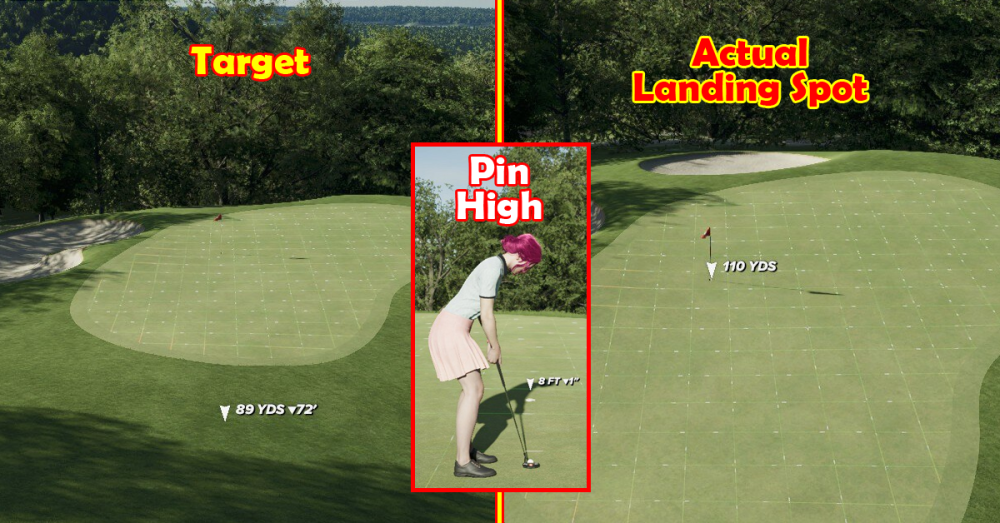
As you play more and more rounds, you will begin to develop an intuitive understanding of wind calculations, allowing you to do them more quickly and more accurately. In order to do so correctly, however, it’s important to have an understanding of the other variables which affect your shots so you can learn to more accurately understand what variance is from wind and what is explained by other factors. Key considerations to keep in mind when calculating for wind are:
- Elevation: The first adjustment to make when preparing your landing point is the change in elevation, with downhill shots carrying further and uphill shots coming to a premature landing. Fortunately, this is a broadly direct calculation, with a 1:1 ratio. However, it’s important to remember that when an elevation change is in feet and your shot distance is in yards, this yields a conversion of 1 yard of distance for every 3 feet of elevation change.
- Example: A shot with a base range of 170 yards into 15 feet of elevation will play like a 165 yard shot as it loses 15 feet, or 5 yards, of length due to the height.
- Shot Type: Because wind effects the ball while it’s in the air, the lower your shot angle, the less you would expect it to be affected by the wind. YouTuber and PGA 2K expert Ma_Kachada has gone in-depth in wind testing and found both that pitch shots tend to max out at just a few yards of wind impact, and that the spinner shot has the effect of nearly entirely negating wind, allowing for far more accurate approaches from in close during high winds.
- Club Selection: Similar to shot type considerations is the magnitude of swing you are putting on the ball, with abbreviated backswings leading to balls which spend less time in the air relative to your expected flight time with that club, resulting in a reduction of wind impact. This means that you can lower the amount of wind adjustment required by clubbing up one or two clubs, allowing you to cut down on your swing and minimize wind movement.
How To Adjust For Head And Tail Winds

Distance control is a critical consideration on any shot. Off the tee and on Par 5 second shots having distance control allows you to dial in your landing zone to set yourself up with your ideal approach to the green. If you have a particular shot you are comfortable hitting — or a particular shot that works best for the green you’re approaching — distance control on the shots leading up to your approach lets you position yourself in your ideal range to then use distance control on your approach to hunt the pin.
When calculating for the length impact of winds, there are three potential calculations to use:
- Tailwinds: Unfortunately, the least impactful alteration the wind brings to the table is when you have a tailwind pushing your ball forward, but that’s not to say it can’t still help you get the extra yards you need to find yourself on a green early and putting for eagle. The calculation for tailwind is to add .8 yards of carry for every 1 mph of rear wind.
- Example: A shot lined up from 150 yards with a 15 mph tailwind leads to a calculation of 15 x .8 = 12; this adds 12 yards of carry for a landing point of 162 yards.
- Approach Headwinds: The next type of wind to consider is the impact of hitting into the wind on approaches. Headwinds in general are more impactful on your shots, so even on a shorter shot like an approach you have to increase the multiplier you use to 1.2.
- Example: A shot lined up from 100 yards with a 10 mph headwind leads to a calculation of 10 x 1.2 = 12; this subtracts 12 yards of carry for a landing point of 88 yards.
- Full Shot Headwinds: While calculations are stable at all lengths for tailwinds, headwinds become more impactful on longer shots. When hitting full length shots the multiplier increases to 1.5 yards for every mph of wind.
- Example: A shot lined up from 150 yards with a 10 mph headwind leads to a calculation of 10 x 1.5 = 15; this subtracts 15 yards of carry for a landing point of 135 yards.
How To Adjust For Cross Winds
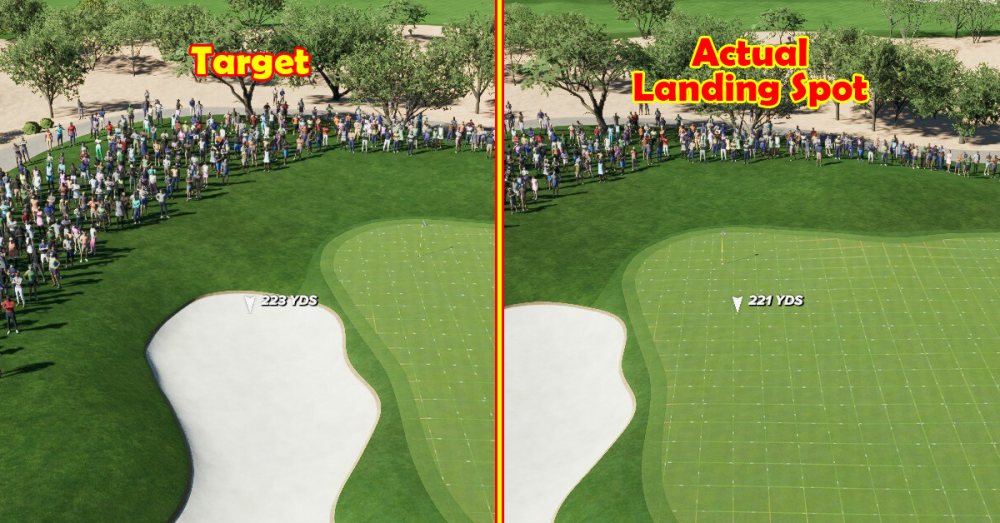
Now that you understand how to adjust your ranges for the wind you need to focus on your aiming, which can be altered significantly by a crosswind. While it may seem like there would be one universal adjustment to your shot regardless of which direction the crosswind moves, it’s actually important to understand your shot shape to more-accurately adjust, which can become crucial for stronger winds where even a slight alteration to the modifier has big effects.
- Wind Following Your Shape: The simplest wind calculation you can make in PGA 2K25 is when the crosswind is moving with your natural arc. This means wind moving right to left if you hit a draw, or left to right if you hit a fade, resulting in the winds assisting your ball in its natural movement. For these shots, it’s a simple 1 yard of movement per 1 mph.
- Example: A shot lined up from 150 yards with a 10 mph crosswind matching your shot shape requires a target point that is 10 yards into the wind.
- Wind Opposing Your Shape: Things get a little more complicated than simply counting when the wind is opposing your arc, such as a draw into left-to-right winds or a fade into right-to-left winds. In this scenario the multiplier becomes 1.2 yards of movement for every 1 mph of wind.
- Example: A shot lined up from 150 yards with a 10 mph crosswind opposing your shot shape leads to a calculation of 10 x 1.2 = 12; this requires a target point that is 12 yards into the wind.
Putting It All Together

While this would all make wind calculation an exact science in a world where every piece of wind is directly oriented as a crosswind, headwind, or tailwind over a flat surface, in reality you will be hitting into winds that almost always have some degree of both left-to-right and front-to-back movement on your ball and often into some degree of elevation change.
To combine all these techniques, first calculate your target landing point without wind, factoring in just elevation and, should you have strayed off the fairway, any distance percentage decrease from your lie indicator. With that point in mind you can now adjust for wind.
If the wind is very nearly aligned parallel or perpendicular to your flight path, you can broadly treat them as direct wind calculations with just a minor adjustment. For example, a shot with mostly a tailwind allows you to calculate for tailwind, then simply move your target a short distance back and into the side-to-side direction.
For more severely-angled winds, you need to estimate how much of that total wind speed will hit your distance and how much will be translated side-to-side. While it’s not necessary to perform precise geometric triangle calculations on every shot, the more shots you play in winds the more comfortable you will become accurately estimating.
Example: A shot lined up from 150 yards faces a 10 mph wind that biases more toward headwind than it does toward supporting your shot shape. Applying this as 6 mph crosswind and 8 mph headwind, the correct target becomes 6 yards into the wind and 12 yards further than the target.
An important thing to note is that you are not simply assigning the total mph to the two axes, as the rule of triangles says that the two sides, your horizontal and vertical movement, will always total more than the long side, the total wind speed. Here are two basic triangle shapes to understand, from which you can then adjust slightly to meet the actual angles of your winds:
- The 45, 45, 90 Triangle: If the wind seems to be evenly split between crosswind and head- or tail wind, you have a 45, 45, 90 triangle which results in both receiving 70-percent of the full wind force.
- Example: Hitting into a 10 mph wind that is evenly split leads to a calculation of 10 mph x .7 = 7 mph; You would apply both 7 mph to your crosswind and head- or tailwind calculations.
- The 3, 4, 5 Triangle: If the wind is slightly biased toward either crosswind or head- or tailwind you can use the 3, 4, 5 triangle. In this case, the direction receiving more of the wind gets a .8 multiplier while the other direction receives a .6 multiplier.
- Example: Hitting into a 10 mph wind that is roughly 1.5 times more biased toward crosswind leads to a calculation of 10 mph x .8 = 8 mph of crosswind and 10 mph x .6 = 6 mph of head- or tailwind; You would apply 8 mph to your alignment and 6 mph to your distance.
This creates three simple reference triangles, an even split, alignment biased and length biased. With those frameworks in place you can then make small tweaks as needed to better represent the actual angle of your winds. With a little practice and time on the course, this will become easier and easier for you, allowing you to develop your wind-reading into a dangerous weapon that lets you out-shoot the opposition when the conditions play rough.


Published: Mar 13, 2025 01:57 pm