


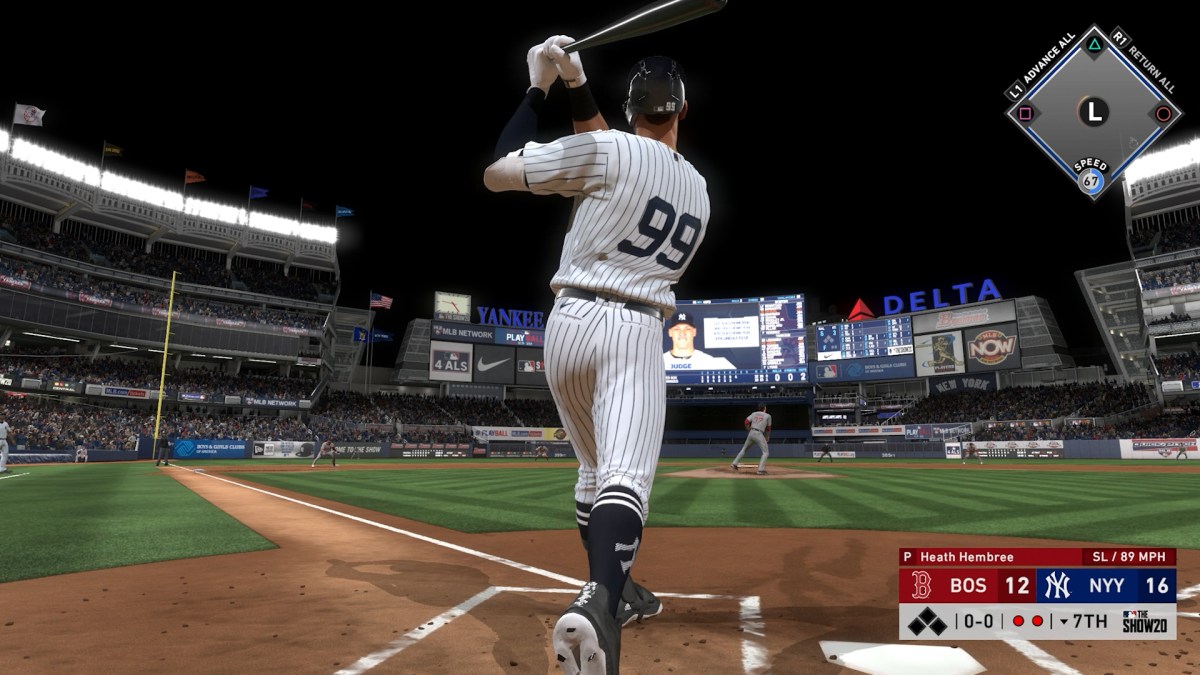
It’s easy for newcomers to the MLB The Show series to dismiss the camera angles used as nothing more than aesthetic preferences. But this is where such newcomers would be wrong. There’s an old adage in baseball: See the ball, hit the ball. And suppose you’re not using a camera angle that allows you to track a pitch and identify its movement properly. In that case, you won’t have a good time at the plate, especially online in competitive environments such as Diamond Dynasty.
MLB The Show 25 gives players an abundance of options when it comes to camera angles they can use when hitting. But which ones have a proven track record of success? Here are the best hitting camera settings in MLB The Show 25.
Best Hitting Views In MLB The Show 25


Operation Sports App
Your ultimate companion for sports gaming. Access in-depth coverage, thoughtful discussion, and a community built around the games—and sports—you love.
Your ultimate sports gaming companion.
Strike Zone

One of the most common camera angles, Strike Zone, is about as basic as camera angles go in MLB The Show 25. Essentially, it’s a no-frills, behind-the-plate view that is about as zoomed in as possible without compromising players’ range of vision.
One of the biggest benefits of Strike Zone is that it restricts your view so that you’re only focusing on the zone and the pitcher. All other distractions — such as the hitter’s movement — are out of sight and out of mind, allowing you to focus on one thing and one thing only: Hitting the ball.
Strike Zone High

The differences between Strike Zone High and the normal Strike Zone view are admittedly marginal at best. That said, in a game as meticulous as baseball, the smallest changes to anything can yield big results.
The difference between Strike Zone High and its normal variant is that High angles the camera ever so slightly above the zone. Personally, I use this camera whenever I’m in a funk and have begun chasing pitches above the zone.
So yeah, the differences between Strike Zone High and Strike Zone are minuscule. But those differences certainly add up.
Strike Zone 2

Strike Zone 2 is pretty similar to Strike Zone High, except that it’s not as zoomed out. For some, this may prove to be a distraction. For others, it will better help them identify pitches that are out of the zone.
If Strike Zone High theoretically helps you identify pitches that are above the zone much more easily, then Strike Zone 2 can help you identify what’s too low.
I’ve only dabbled with Strike Zone 2 and have preferred switching between normal Strike Zone and Strike Zone High. But, in the spirit of “different strokes for different folks,” I’d be remiss not to mention Strike Zone 2 as a viable option for hitting, especially when some of the top online players use it.
Other Visual Aids To Keep In Mind

Picking a camera angle is only one of the things that can help you while at the plate in MLB The Show 25. Another key piece to the visual puzzle is choosing your Plate Coverage Indicator (PCI).
We’ve already mentioned the PCI in our past article about helping you get better at hitting in MLB The Show 25, but here’s a quick refresher.
Unlike the camera angle you choose to use when at the plate, the PCI you choose to use is completely up to you and dependent upon your preferences. For instance, I like using the Altitude PCI center with the Starfighter PCI as my outer. I typically play on Hall of Fame and Legend difficulty online, and even if it’s just a visual aid that provides no advantage whatsoever, I prefer having a larger PCI just to give me the feeling of playing on a lower difficulty.
Another popular choice for your PCI is to strip away its outer and middle components, and use only the Bat as your center aid. Apparently, it gives players a better indication of where they’re making contact and could (in theory) give you a better feel for where the barrel of the bat is.
So yeah, if you’re looking to get better at hitting in MLB The Show 25 — especially online — these are the camera settings you should be experimenting with.




Published: May 29, 2025 12:01 am